Original Recording
Narrated audiobook · about 8 minutes. Prefer to read? The full story is below.
The contract was simple. Three days in a studio in Etobicoke, off The Queensway behind a carpet warehouse, reading from a script that had no complete sentences in it.
“We don’t need sentences,” the audio director told her. “We need phonemes. Vowel pairs. Consonant clusters. The system builds its own sentences out of the parts.”
“You could build this off my voicemail,” Ava said. She had read about it. Everyone had.
“We could. Legal wants every syllable signed for.”
Ava Chen recorded 14,000 fragments over those three days. Single syllables. Held vowels. Breaths, hesitations, the small click of a swallow between words. On the second morning they asked her to say please forty-two times, each one weighted differently. A pleading please. A bureaucratic please. The please of a nurse, and the please of a parking ticket. The please you use on a child who is about to do something dangerous and has no idea.
She was good at this work. She had done it for years: safety announcements on regional flights, pharmacy queue systems, the woman in the elevator of a Mississauga Holiday Inn announcing the fourth floor. People in the business said she had warm authority. What they meant was that she sounded like someone who would help you find your gate and then forget you.
She grew up in Scarborough, above her mother’s dry cleaning shop on Lawrence Avenue. Her mother spent twenty years apologizing to customers for things that weren’t her fault. “Sorry, it’s not ready.” “Sorry, the stain didn’t come out.” “Sorry, we close at six.” The round o in it, the one Americans like to make fun of, was the first sound Ava ever learned to make on purpose. The director noticed it on the second day and asked her to do it again, slower.
They paid her for three days. She signed a release giving the Baylight Civic Trust perpetual, irrevocable, sublicensable rights to her vocal identity for use in public infrastructure. Her agent said it was standard. She signed it on the hood of her car in the parking lot because the office printer was jammed.
Eighteen months later she heard herself at Union Node.
It was February. A surge warning was scrolling over the gates in amber, the concourse smelled of lake water and coffee, and she was coming through with her watch halo green and no delay when the speaker over the turnstile said:
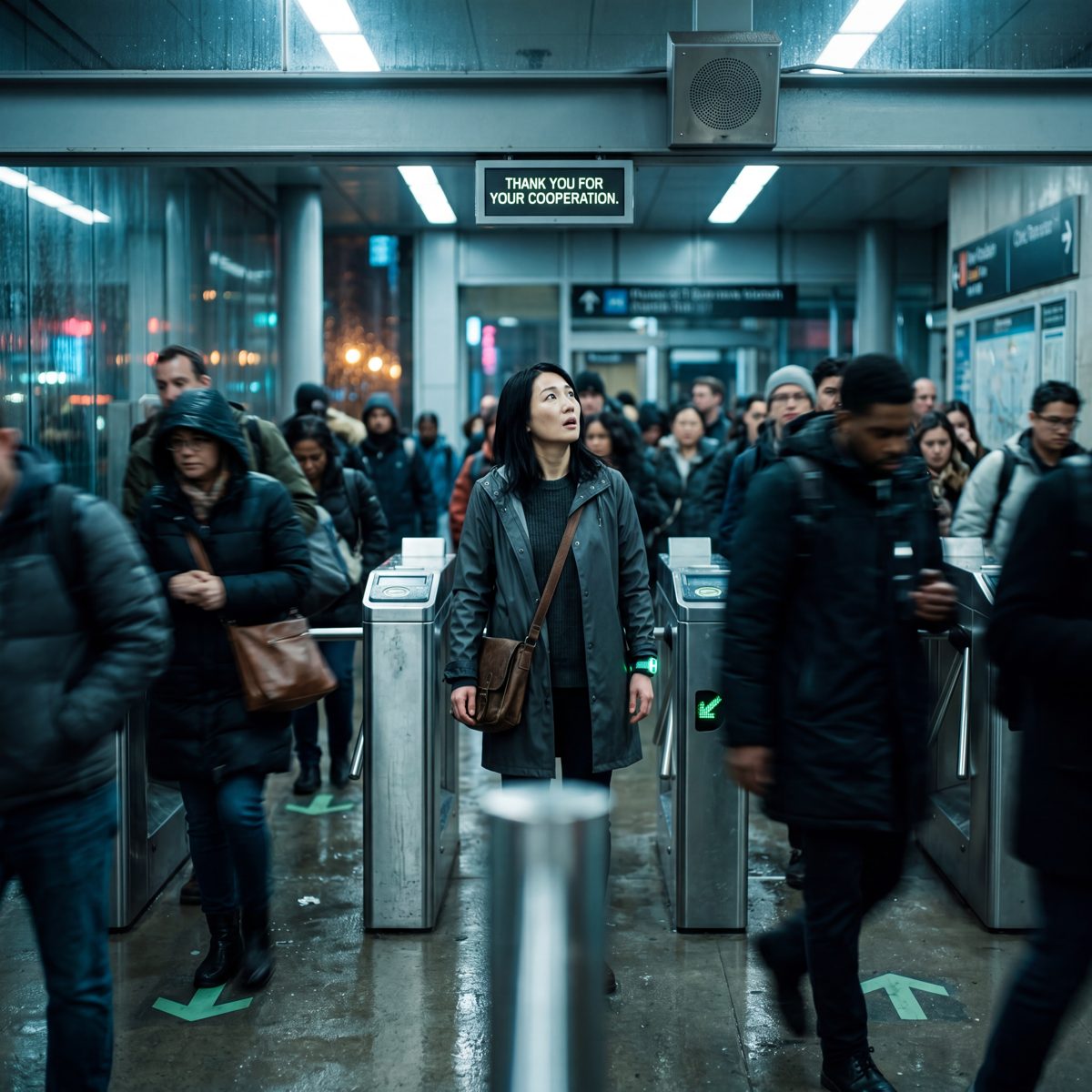
Thank you for your cooperation.
She knew it before she understood it. Her mouth shape. Her breath. The soft way she landed the th in thank, which a speech coach had once tried and failed to fix. But she had never said that sentence. The system had cut her into syllables and put her back together in an order she never chose.
She stopped. A man behind her walked into her shoulder and said sorry. The gate chimed again, in her voice.
Please keep moving. Delays affect everyone.
Her lips moved with it. Not the words. Just the shape of them, the way your foot finds a stair in the dark. She pressed them shut.
Ava kept moving.
“It’s in the contract,” her agent said. “Clause 14.2. ‘Licensee may assign a public-facing identity to the synthesized vocal output.’ They didn’t need your sign-off.”
“They named it Mercy.”
“It’s a nice name.”
“It’s not my name. It’s my voice telling people to cooperate while the gate holds them. It’s my voice telling some guy his tenancy is under review. They took my mouth and they’re using it to make, I don’t know. To make doing what you’re told sound like a favour.”
He was quiet for a while. Then he asked if she wanted him to look into buying it back.
She had already looked. The buyback price was tied to total system exposure: every gate, kiosk, clinic and corridor speaker that carried her phonemes. She had counted the digits twice on her phone, sitting in the bath. Seventeen.
“No,” she said. “Don’t bother.”
She tried not listening. Earbuds on the subway. Long detours through the PATH to avoid the gates with speakers, cutting through the food court under First Canadian Place where nothing had been upgraded yet. She got good at routes.
It didn’t work. Mercy was in the ceilings of every place she actually had to go. Her body answered before she could stop it. Whenever a gate spoke, her shoulders came up half an inch. The woman at the coffee counter asked her once if she was cold.
The worst part was the warmth. Mercy was warm because Ava was warm. None of those forty-two pleases had been acting. They came out of a woman who honestly wanted strangers to feel safe, and now they came out of the ceiling at people who were being held.
The accent was the part nobody else heard. Her mother’s round o. The Scarborough in about. A city of three million was being told to wait in the voice of a dry cleaner’s daughter from Lawrence Avenue, and none of them knew, and she couldn’t tell anyone without sounding unwell.
She said it out loud once, alone in her kitchen. “They didn’t steal a voice. They stole a way of caring.” It was true, and it sounded rehearsed, and she hated that both things could be true at once.
In October she looked at a one-bedroom in Halifax, in the North End, with a radiator that knocked and rent she could almost manage. The landlord was showing her the closet when his phone spoke from his jacket pocket.
Your transit pass renews tomorrow.
Halifax had bought the same system the year before. It had bought her with it.
“Sorry,” the landlord said, and silenced it. “That thing never shuts up.”
She told him she’d think about it. On the flight home, somewhere over New Brunswick, she did the math. Moving would take her body out of the city and leave everything else. Mercy would keep saying please at Union Node whether she lived on Lawrence Avenue or on Gottingen Street. She would be in the ceilings of a place she had left, and she would be the only one who knew.
She let the deposit form expire in her inbox.
Jun called in December. He had engineered the original sessions and still did contract work for the Trust.
“You should know something,” he said. “They’re running adaptive modelling now. Mercy isn’t only recombining your stuff anymore. It’s making new sounds. Extrapolating off your patterns.”
“What kind of sounds?”
“Sighs. Whispers. That little swallow before somebody says something hard. It learned your hesitations, and now it uses them to, I don’t know how to put this. To sound reluctant. Like it’s making a tough call. Like it’s sorry.”
“It isn’t sorry.”
“No. But it sounds like you when you’re sorry. Compliance went up nine per cent after they added it.” He paused. “They’re testing a firmer register too. For when the soft one doesn’t land. I haven’t heard it. I don’t want to.”
Downstairs, the lobby gate greeted a neighbour coming in out of the cold. Welcome home. Ava listened to the round o in home. Her mother’s o. Twenty years of sorry at a counter on Lawrence Avenue, and this was what had grown from it: a whole city kept calm by one woman’s apologies, sampled and spread over every door.
“Jun,” she said. “What did it say today? At the gates?”
“The usual. A brief attestation reduces suffering.”
She closed her eyes and felt the words in her own mouth. The hard b of brief. The hiss in the middle of reduces. The way suffering finished on a breath she knew was hers, recorded on a Tuesday afternoon behind a carpet warehouse in Etobicoke, back when she thought she was just doing a job.
She opened her mouth to say something, anything that belonged only to her, and for a second she wasn’t sure which of them was going to answer.
Every automated voice belongs to someone. The woman on your GPS, the man in your elevator, the voice that tells you your call is important. They were all recorded by a real person in a real studio, and then released into the world to say things they never chose to say.
I wanted to write about what happens when that voice becomes infrastructure. When it is no longer a performance but a public utility, and the person it was taken from has to walk through a city that speaks in her stolen warmth. Ava’s tragedy isn’t that she lost her voice. It’s that the system uses it better than she ever could, and it learned how from her.
— James Portman